What keeps a turbine blade from melting in scorching heat? Standard metals often fail under extreme thermal stress. This demands a specialized manufacturing solution.Heat-resistant steel castingsolves this critical challenge. It creates components that withstand temperatures above 1200°F. These parts resist warping and corrosion perfectly.In this guide, you will learn the entire manufacturing process. We cover sand molding, investment casting, and material selection. Discover how to produce durable, high-performance castings for demanding applications.
What is Heat-Resistant Steel Casting?
Heat-resistant steel casting makes special metal parts. These parts work in extremely hot environments. They perform above 1200°F continuously.
Its secret lies in the special material mix. It contains high amounts of nickel and chromium. Nickel can reach up to 70 percent. Chromium ranges between 10 and 30 percent.
This combination creates a protective oxide layer. It shields the metal from heat damage. Regular steel castings cannot do this. They would fail quickly under thermal stress.
Why Choose Casting for Heat-Resistant Components?
Casting offers incredible design freedom. You can create complex internal channels. Forging cannot achieve these geometries.
It provides excellent material efficiency. The process is near-net-shape. You minimize waste of expensive alloys.
Casting proves cost-effective for complex parts. It beats machining a solid block. You save both time and money.
It delivers superior structural integrity. The grain structure becomes homogeneous. This ensures perfect thermal stability.
Key Manufacturing Processes
Sand Mold Casting: The Versatile Workhorse
Sand mold casting uses a disposable mold. We form it around a pattern. It works for large, complex parts.
This method suits low-to-medium production volumes. It handles heat-resistant steel very well. Recent advances include 3D printed sand molds. They allow rapid prototyping.
Investment Casting: For Maximum Precision
Investment casting is our specialty at ZR. It uses the "lost wax" process. This achieves exceptional surface quality.
It offers superior dimensional accuracy. Parts have intricate details and thin walls. They need minimal machining afterward.
Comparing Casting Methods
| Feature | Sand Mold Casting | Investment Casting |
Best For | Large components | Complex, intricate parts |
Surface Finish | Rougher | Very Smooth |
Dimensional Accuracy | Good | Excellent |
Cost Profile | Lower for large parts | Competitive for complexity |
Lead Time | Medium | Medium to Long |
Manufacturing Process Step-by-Step
First, we create the pattern and mold. It forms the part's negative space. We use either sand or wax.
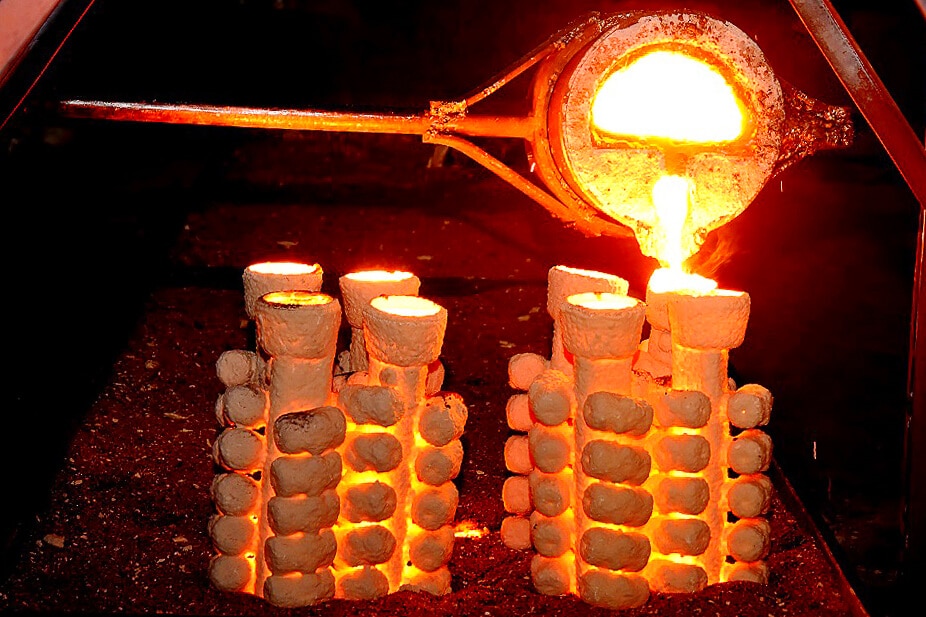
Next comes melting and pouring. We superheat the steel alloy. Then we pour it carefully into the mold.
Cooling and solidification follow. This phase creates the microstructure. We control it very precisely.
Then we remove the shell and clean. We break away the mold material. The raw casting appears inside.
Heat treatment comes next. It enhances high-temperature strength. This step relieves internal stress.
Finally, we perform finishing and quality control. We machine to final dimensions. We test with X-ray and ultrasonic methods.
Overcoming Key Challenges
High melting points demand special furnaces. We use advanced refractories. They withstand extreme temperatures.
Shrinkage and cracking require careful control. We design molds specifically. Cooling rates are managed precisely.
Porosity and defects are minimized. We implement strict process controls. Our gating systems are optimized.
Material segregation must be prevented. It ensures even alloy distribution. We achieve consistent quality.
Selecting the Right Alloy
Consider these common grades:
Stainless Steel 304 (CF8): Good for general applications. It resists oxidation well.
Stainless Steel 316 (CF8M): Superior corrosion resistance. Handles higher heat levels.
High-Nickel Alloys: For extreme conditions. They withstand corrosive environments.
We help you choose the perfect material. Our expertise guides your selection.
Industries and Applications
Many industries use these castings:
Aerospace: Turbine blades, engine mounts
Power Generation: Valve bodies, turbine housings
Petrochemical: Furnace tubes, pipeline parts
Automotive: Turbocharger housings, exhaust manifolds
Industrial Furnaces: Baskets, rollers, radiant tubes
ZR Investment Casting: Your Partner
We offer complete in-house capabilities. Our Heat‑Resistant Steel Casting services cover everything. We handle mold design to final machining.
We specialize in stainless steel. High-alloy materials are our expertise. Your components will perform perfectly.
Our quality control is rigorous. Every casting meets high standards. They withstand extreme temperatures reliably.
We provide custom engineering support. Our team optimizes your designs. We ensure manufacturability and performance.
Conclusion
Manufacturing heat-resistant steel casting is complex. It blends advanced material science with precision engineering. This creates parts for extreme temperatures.
Choosing the right manufacturing partner is crucial. They help you navigate production challenges. You achieve reliable, high-performance components.
Trust ZR Investment Casting for your project. We deliver quality and expertise. Contact us to get started today.
Frequently Asked Questions (FAQ)
Q: What temperature can heat-resistant steel castings withstand?
A: They work continuously above 1200°F (650°C). Some special grades handle over 2000°F (1100°C).
Q: Why is sand molding often used for these castings?
A: It fits large, complex parts perfectly. This method is very flexible and cost-effective.
Q: Can you achieve a smooth surface finish on a heat-resistant casting?
A: Absolutely. Our investment casting specialty creates very smooth surfaces. This reduces your machining needs.
Q: How does ZR Investment Casting ensure quality in these critical components?
A: We use strict quality controls. This includes mold flow analysis and precise heat treatment. Every part gets reliable performance.


