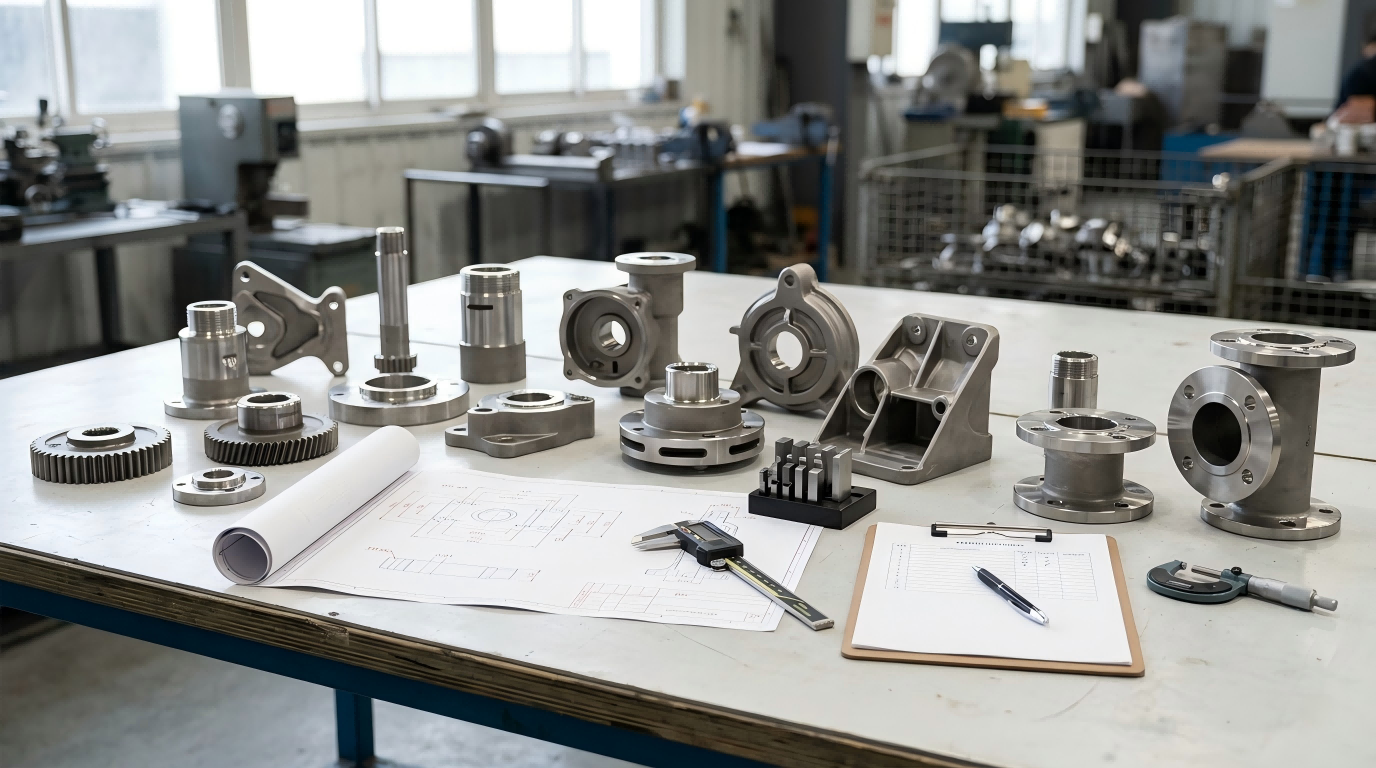
Investment Casting & CNC Machining Case Studies
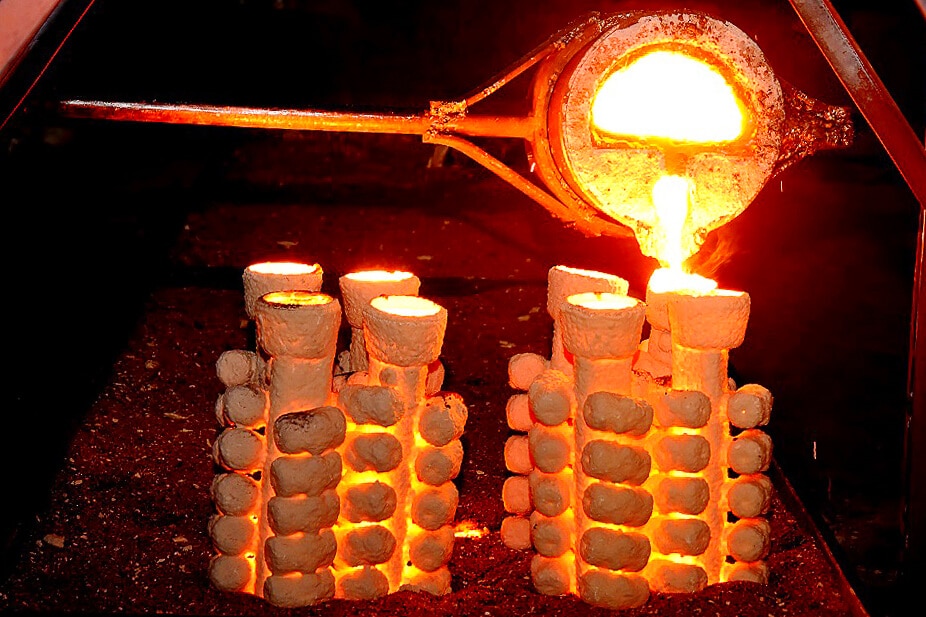

CASE 01
Duplex Stainless Steel Manifold
Industry: Pump & Valve
Material: Duplex Stainless Steel
Project Focus: Internal Surface Quality & Dimensional Stability
The Challenge / Problem
The manifold was produced from multiple wax-pattern sections, with joints located deep inside the internal passages. These areas were difficult to access after assembly, creating rough and uneven internal surfaces.
The relatively large size of the component also made its broad flat surfaces more susceptible to dimensional variation during wax-pattern preparation.
Our Engineering Solution
After joining the wax-pattern sections, dedicated hand tools were used to smooth and refine the internal joint areas before shell building.
During wax injection and pattern preparation, the large flat surfaces were repeatedly checked and corrected against a flat reference surface before the parts were released to the next production stage.
Result
The revised process improved internal surface consistency while providing better control of flatness and verticality.
By addressing these issues during wax-pattern preparation rather than relying only on downstream correction, the process became more suitable for stable repeat production.
CASE 02
316 Stainless Steel Pressure Valve Body
Industry: Pump & Valve / Industrial Equipment
Material: 316 Stainless Steel
Project Focus: Complex Internal Cavity & Sand Removal
The Challenge
The valve body contained a complex enclosed internal cavity with only a limited external opening.
This made conventional tooling and post-casting sand removal difficult while the finished component still needed to meet functional sealing requirements.
Our Engineering Solution
The component design and manufacturing route were reviewed together.
A temporary access opening was introduced to make the internal structure manufacturable. After casting and internal cleaning, the opening was closed using a stainless steel plate with a specially designed joint configuration.
A high-temperature-resistant sand core was used to form the internal cavity and provide sufficient strength during casting while allowing subsequent removal.
Result
The revised manufacturing approach made the complex internal cavity practical to produce while maintaining the required functional characteristics of the valve body.
It also reduced the difficulty of internal cleaning and provided a more controlled production route for the component.


CASE 03
High-Precision AISI 5140 Equipment Component
Industry: Industrial Machinery
Material: AISI 5140 / 40Cr Alloy Steel
Project Focus: Deformation Control & Dimensional Stability
The Challenge
The component had demanding dimensional requirements combined with several unsupported features, making it susceptible to deformation during different stages of production.
The application also required a combination of high hardness and adequate toughness, increasing the importance of overall process stability.
Our Engineering Solution
Temporary reinforcement features were added around selected openings to improve structural stability during production and were removed during subsequent finishing.
During wax-pattern preparation, dedicated support blocks were used in deformation-sensitive areas to help maintain geometry.
The post-casting cleaning process was also adjusted to reduce unnecessary impact on the component and limit additional deformation.
Result
The combined process improvements provided better dimensional stability and reduced deformation through the production cycle.
The more controlled manufacturing route also helped improve production consistency for this geometry.
CASE 04
Thin-Walled Alloy Steel Connection Clamp
Industry: Transportation
Material: Alloy Steel
Project Focus: Thin-Wall Filling, Shrinkage & Opening Deformation
The Challenge
The component combined a thin-wall structure with an open geometry that was highly susceptible to deformation.
Its surrounding teeth and functional features also restricted possible gate locations, making conventional feeding difficult and increasing the risk of shrinkage.
Our Engineering Solution
A temporary connection was introduced across the opening during casting, creating a more stable location for the feeding system while simultaneously supporting the deformation-sensitive area.
After casting, the temporary connection was removed using a dedicated checking fixture to control the final geometry.
Result
The revised process improved casting stability without requiring a fundamental change to the functional design of the finished component.
The temporary support and controlled removal method provided a practical solution for both feeding and deformation control.

Stainless Steel Diffuser & Valve Components
Material: 304 Stainless Steel
Challenge:
Curved internal passages and difficult shell/sand removal.
High-temperature-resistant sand cores were introduced to form the internal passages while improving accessibility during post-casting cleaning.
Focus:
Internal Cavities · Sand Core Design · Casting Process


Cost-Optimized Carbon Steel Wrench Component
Material: Carbon Steel
Challenge:
The long geometry was difficult to cast as a single piece, while subsequent decorative finishing made surface imperfections more visible.
The design was divided into a cast functional section and a fabricated steel handle, followed by joining and finishing.
Focus:
Design for Manufacturing · Hybrid Manufacturing · Cost Optimization
Stainless Steel Transportation Component
Material: 304 Stainless Steel
Challenge:
Internal shrinkage became visible only after machining, while an open central section was susceptible to dimensional variation.
The feeding system was revised to improve shrinkage compensation, while auxiliary checking tools were introduced for dimensional control.
Focus:
Shrinkage Control · Gating Optimization · Dimensional Inspection


Complex 316 Stainless Steel Body
Material: 316 Stainless Steel
Challenge:
A multi-section geometry made one-piece tooling impractical, while the finished component required good verticality.
Separate wax-pattern sections were aligned using dedicated tooling, followed by post-casting shaping and fixture inspection.
Focus:
Tooling Strategy · Wax Pattern Alignment · Verticality Control