Engineers often face a frustrating paradox: the component that performs best in a simulation is frequently the hardest to manufacture. You might design a part with optimal fluid dynamics or lightweight structural integrity, only to find that traditional CNC machining or sand casting cannot produce it economically. This "impossible geometry" dilemma forces compromises that sacrifice performance for manufacturability. However, there is a strategic alternative that bridges this gap.
Lost Wax Casting, also known as investment casting, acts as a critical solution for "near-net shape" production. It is not merely a manufacturing method; it is a design enabler that allows for intricate details and complex internal structures without the prohibitive costs of machining from solid billets. By prioritizing precision at the casting stage, manufacturers can drastically reduce downstream processing.
While the process involves higher initial setup complexity compared to simple fabrication, it frequently offers the lowest Total Cost of Ownership (TCO) for sophisticated industrial applications. By eliminating secondary processing steps and assembly requirements, it transforms how engineers approach component design. In this article, we will explore why this ancient technique remains the cutting-edge standard for high-precision manufacturing.
Key Takeaways
Precision at Scale: Achieves tolerances of ±0.005 inches and surface finishes of 125 RMS, often removing the need for post-cast machining.
Geometric Freedom: Capable of casting undercuts, thin walls, and internal channels that are impossible with die casting or machining.
Material Agnostic: Supports a vast spectrum of alloys—from Aluminum and Stainless Steel to high-temp Superalloys—without changing tooling logic.
Economic Sweet Spot: High tooling ROI for production runs where part consolidation reduces assembly labor and inventory costs.
Solving Geometric Complexity: The "Near-Net Shape" Advantage
The primary driver for choosing investment casting over other methods is its ability to produce geometries that defy the limits of traditional tooling. When a design requires internal pathways or non-linear shapes, subtractive manufacturing hits a wall.
Beyond Machining Limits
CNC machining is strictly line-of-sight. If a cutting tool cannot reach a surface, it cannot machine it. This limitation often forces engineers to split a complex part into two halves, machine them separately, and then bolt or weld them together. The ceramic shell process used in High Precision Lost Wax Casting eliminates this constraint. Because the ceramic shell is formed around a wax pattern and then removed, we can cast deep undercuts, curved internal cooling channels, and blind holes directly.
Consider a hydraulic manifold. Machining the internal galleries requires drilling from the outside and then plugging the access holes, creating potential leak points. With lost wax casting, these galleries are formed by the ceramic core, resulting in a seamless, leak-proof component straight from the mold.
Thin-Wall Capabilities
Weight reduction is a critical mandate in aerospace and medical device sectors. Engineers constantly seek to shave grams without compromising structural integrity. Lost wax casting excels here, capable of producing wall thicknesses as low as 1.5mm (0.060 inches) reliably.
This capability stands in stark contrast to sand casting, which generally requires thicker walls (3-5mm) to ensure molten metal flow without freezing prematurely. Similarly, while high-pressure die casting can achieve thin walls, it often struggles with internal porosity in thicker joining sections. The investment casting process uses a hot ceramic shell, which prevents the metal from cooling too quickly, allowing it to fill thin sections completely before solidifying.
Part Consolidation: The Assembly Killer
One of the most powerful economic arguments for this process is part consolidation. Many industrial assemblies consist of a fabricated bracket welded to a tube, which is then bolted to a flange. This approach introduces multiple failure points:
Weld fatigue zones.
Fastener loosening.
Gasket leaks.
By redesigning this assembly as a single, integral casting, you eliminate the labor costs associated with welding and assembly. You also simplify inventory management—stocking one part number instead of five. The resulting component is stronger, lighter, and more aesthetically pleasing.
Material Versatility and Surface Quality
Design freedom means little if you are restricted to weak materials. Fortunately, the investment casting process is chemically inert, allowing it to accommodate a broader range of alloys than almost any other casting method.
Unrestricted Alloy Selection
Die casting is predominantly limited to non-ferrous metals with low melting points, such as zinc, magnesium, and aluminum. If your application requires the strength of steel or the heat resistance of superalloys, die casting is off the table.
Lost wax casting imposes no such limits. It is the standard method for producing turbine blades from nickel-based superalloys (like Inconel) that must withstand temperatures exceeding 1000°C. For applications requiring robust corrosion resistance, Stainless Steel Metal Lost Wax Casting ensures components can survive harsh chemical environments or marine applications.
Simultaneously, for sectors prioritizing weight reduction, Aluminum Investment Lost Wax Casting provides a high-strength-to-weight ratio without the porosity issues often found in die-cast aluminum. This versatility allows engineers to switch alloys during the prototyping phase without necessarily scrapping the tooling logic.
Superior Surface Finish
Surface roughness is a hidden cost in manufacturing. A rough casting requires aggressive grinding and polishing to meet aesthetic or functional standards. Sand castings typically result in a rough, pebble-like texture (Ra 12.5–25 microns).
In contrast, investment casting replicates the smooth surface of the original wax pattern. Typical production runs achieve roughness averages (Ra) of 3.2 to 6.3 microns (approximately 125 RMS). For many applications, this is a "no-polish" finish. In food processing equipment or medical tools, where surface hygiene is critical to prevent bacterial growth, this superior finish significantly reduces post-processing costs.
| Feature | Sand Casting | Lost Wax Casting | Die Casting |
| Surface Finish (Ra) | 12.5 - 25 µm (Rough) | 3.2 - 6.3 µm (Smooth) | 1.6 - 3.2 µm (Very Smooth) |
| Material Choice | Excellent (Ferrous/Non-ferrous) | Excellent (All Alloys) | Limited (Non-ferrous mostly) |
| Complex Geometries | Low to Medium | Very High (Undercuts OK) | Medium (No Undercuts) |
| Wall Thickness | Thick (>3mm) | Thin (>1.5mm) | Very Thin (>1mm) |
The Financial Case: ROI and Total Cost of Ownership (TCO)
Procurement teams often balk at the initial price per unit of an investment casting compared to a raw welded assembly. However, looking at the unit price in isolation is a mistake. The real value becomes visible when analyzing the Total Cost of Ownership.
Upfront vs. Long-Term Costs
We must address the "elephant in the room": tooling costs. Creating the aluminum injection die for the wax patterns is an upfront investment. It is more expensive than the wooden patterns used in sand casting. However, it is significantly cheaper than the hardened tool-steel molds required for high-pressure die casting.
The break-even analysis usually favors investment casting when complexity is high. If a part requires five different setups on a CNC machine to finish, the cost of machining time quickly eclipses the cost of the casting. With Customized Lost Wax Casting, we aim to eliminate 50% to 80% of these secondary machining operations. You pay for the mold once, but you save on machining hours for every single unit produced thereafter.
Reduction of Waste
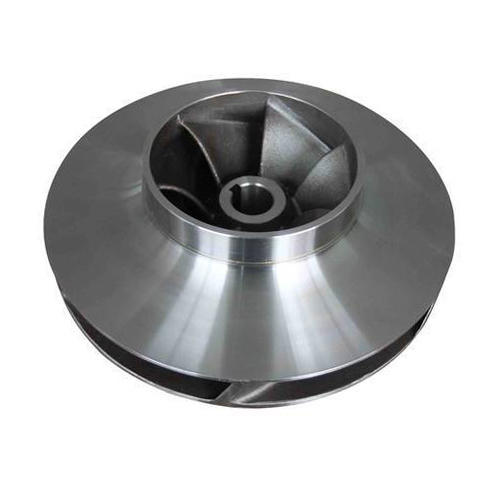
CNC machining is a subtractive process. To make a 1kg impeller, you might start with a 4kg block of metal and machine away 3kg of chips. When dealing with cheap mild steel, this waste is negligible. When working with Titanium, Hastelloy, or Cobalt-Chrome, that waste represents a massive financial loss.
Investment casting is an additive process; we pour only the metal needed for the part and the gate system (which is recycled). This efficiency makes it the only economically viable choice for expensive exotic alloys.
Lifecycle Management
Industrial equipment often has a service life spanning decades. Maintaining an inventory of spare parts for legacy machines is a logistical nightmare. Lost Wax Casting for Spare Parts offers a unique solution.
If the original tooling exists, re-ordering a small batch of replacement parts is straightforward. Even if the tooling is lost, modern 3D printing allows us to print a wax pattern directly from a CAD file. This "digital inventory" means you can produce spares on-demand without warehousing physical stock, keeping legacy equipment running without the overhead of mass production.
Critical Limitations and Risk Assessment
To make an informed decision, engineers must understand not just the benefits, but also the limitations. Investment casting is not a magic bullet for every scenario.
When NOT to use Lost Wax
If a component has a simple geometry—such as a basic flange or a block with a few holes—and can be easily stamped or machined from standard bar stock, investment casting is likely overkill. The process involves multiple steps: wax injection, tree assembly, shell building (dipping and drying multiple times), dewaxing, pouring, and knockout. This makes it inherently slower than stamping or die casting. If you need 100,000 simple washers, stamping is the correct choice, not casting.
Size Constraints
The process is incredibly scalable, handling parts from a few grams up to approximately 100kg. However, there is an upper limit. Extremely large structural components, such as engine blocks for massive ships or large wind turbine bases, are better suited for sand casting. The ceramic shell becomes difficult to handle and prone to cracking at massive scales.
Process Control Risks
Quality control is paramount. Because the shell is a thermal insulator, the metal stays liquid longer, which helps fill details but can lead to shrinkage porosity if not managed correctly. For critical stress-bearing parts, trusting an experienced Lost Wax Casting specialist is essential. They will employ vacuum pouring techniques to remove air pockets and ensure dense, defect-free metal.

Evaluation Framework: Choosing the Right Lost Wax Casting Supplier
Selecting a manufacturing partner is as critical as selecting the process itself. Not all foundries possess the same technical maturity. Here is a framework for evaluating potential suppliers.
Digital Capabilities
Modern casting is data-driven. A top-tier supplier should utilize simulation software (CFD) to predict fluid flow and solidification patterns before a single drop of metal is poured. This digital rehearsal identifies potential defects like cold shuts or shrinkage porosity, allowing for gate design adjustments in the virtual world rather than on the shop floor.
Additionally, look for Lost Wax Casting Supplier capabilities that include 3D printed wax patterns. This allows for rapid prototyping, letting you physically hold and test a cast metal prototype within days, validating your design before committing to expensive metal tooling.
Quality Assurance & Compliance
For industries like aerospace, medical, and automotive, visual inspection is insufficient. Your supplier must have in-house Non-Destructive Testing (NDT) capabilities, including:
X-Ray/Radiography: To detect internal voids.
Dye Penetrant Inspection: To reveal surface micro-cracks.
Spectral Analysis: To verify alloy chemical composition.
Ensure they hold the relevant certifications for your industry, such as ISO 9001 for general industry, AS9100 for aerospace, or IATF 16949 for automotive components. These certifications validate that their process control is rigorous and repeatable.
Conclusion
Lost Wax Casting bridges the gap between the high precision of CNC machining and the volume capabilities of traditional casting. It remains the superior choice when geometric complexity is high, material requirements are strict, and the goal is to reduce total part count and secondary processing.
While the process requires a higher degree of manufacturing expertise, the payoff is significant: lighter parts, stronger integral assemblies, and a lower total cost of production. We encourage engineers to audit their current inventory of "welded assemblies" or "fully machined" complex parts. You may find that converting these legacy designs to investment castings is the key to unlocking better performance and profitability.
FAQ
Q: What is the difference between lost wax casting and investment casting?
A: They are the exact same process. "Lost Wax" refers to the historical technique where the wax pattern is melted out (lost) to create a cavity. "Investment" refers to the modern technical term where the wax pattern is "invested" (surrounded) by a ceramic slurry to form the mold. The terms are used interchangeably in the industry.
Q: Is lost wax casting expensive?
A: It depends on the perspective. The unit price is higher than sand casting, and tooling is more expensive than simple machining fixtures. However, for complex parts, it is often cheaper overall because it eliminates 50-80% of expensive secondary machining and assembly labor. It is the most cost-effective option for complex, high-precision designs.
Q: What tolerances can be held in lost wax casting?
A: The standard linear tolerance is typically ±0.005 inch per inch (approx. ±0.13mm per 25mm). This is significantly tighter than sand casting. For critical features requiring even tighter precision (e.g., bearing fits), a light secondary machining pass is usually performed, but the bulk of the material removal is unnecessary.
Q: Can you lost wax cast aluminum?
A: Yes. While die casting is common for high-volume, simple aluminum parts, aluminum investment casting is used for complex, thin-walled aerospace and electronic housing applications. It offers better surface finishes and can produce geometries (like internal cooling jackets) that die casting cannot achieve.
Q: What is the "Direct" lost wax method?
A: The direct method involves 3D printing the pattern in wax or a castable resin instead of injecting wax into a metal die. This bypasses the need for expensive tooling, making it perfect for rapid prototyping or extremely low-volume production runs where speed is critical.


