Every industrial product that relies on durability, precision, and complex geometry often starts with one fundamental manufacturing method—casting. From automotive components to machinery housings and industrial equipment, casting parts play a critical role in modern manufacturing. Yet many buyers and engineers still face a common challenge: understanding which casting process is best suited for their specific application.
At Foshan Zeren Precision Casting Co., Ltd., we work closely with global clients to manufacture a wide range of metal components using different casting methods. Through years of production experience, we have seen how selecting the right process can significantly affect product quality, cost efficiency, and long-term performance. This article provides a practical overview of four of the most widely used metal casting processes, helping you better understand their differences and how they apply to your project.
What Is Metal Casting and Why Does It Matter?
Metal casting is a manufacturing process in which molten metal is poured into a mold and allowed to solidify into a desired shape. It is one of the oldest and most versatile production methods, capable of producing both simple and highly complex parts.
The importance of casting lies in its flexibility. It allows manufacturers to create intricate geometries that would be difficult or expensive to achieve through machining or fabrication. For industries that demand high strength and durability, casting remains a preferred solution.
More importantly, the choice of casting process directly impacts the final product. Factors such as surface finish, dimensional accuracy, mechanical properties, and production cost are all influenced by the method used.
Sand Casting: The Most Traditional and Flexible Method
How sand casting works
Sand casting remains one of the most widely used manufacturing methods for producing metal components. The process begins with creating a mold cavity using a mixture of sand, clay, and binding agents. A pattern, usually made from wood or metal, is used to form the shape of the final part inside the mold. Once the mold is prepared, molten metal is poured into the cavity and allowed to cool and solidify. After solidification, the mold is broken apart to retrieve the casting.
Because each mold is destroyed after use, sand casting is considered a single-use mold process. However, the sand itself can often be recycled and reused, making it relatively economical.
Advantages of sand casting
One of the most significant strengths of sand casting is its versatility. It supports a wide range of metals, including iron, steel, aluminum, and bronze. The process is also highly adaptable to different sizes, from small precision parts to very large industrial components weighing several tons.
Another key advantage is the relatively low tooling cost. Compared to other casting methods, sand casting does not require expensive permanent molds, making it especially suitable for low-volume production, prototyping, or custom-designed parts. This flexibility makes it a preferred option for many industrial applications.
Limitations to consider
Despite its advantages, sand casting has some inherent limitations. The surface finish is generally rougher due to the texture of the sand mold, and dimensional accuracy is lower compared to more advanced casting processes. As a result, additional machining is often required to achieve tighter tolerances or smoother surfaces.
Typical applications
Sand casting is commonly used for large and heavy components such as engine blocks, pump housings, valve bodies, and structural machine parts. In these applications, strength, size capability, and cost efficiency are more critical than fine surface detail.
Investment Casting: Precision and Complexity Combined
How investment casting works
Investment casting, also known as lost wax casting, is designed for producing highly detailed and precise components. The process starts by creating a wax pattern that replicates the final part. Multiple wax patterns may be assembled into a cluster and then coated with a ceramic slurry. After several layers are applied and hardened, the wax is melted out, leaving behind a hollow ceramic mold.
Molten metal is then poured into the mold. Once the metal solidifies, the ceramic shell is broken away to reveal the finished casting.
Advantages of investment casting
This method is well known for its excellent dimensional accuracy and smooth surface finish. It allows manufacturers to produce complex geometries with fine details that would be difficult or impossible to achieve with other processes.
Another major benefit is the reduced need for secondary machining. Because parts are produced close to their final shape, post-processing requirements are minimized, saving time and cost in certain applications.
Limitations to consider
Investment casting involves more steps and longer production cycles compared to sand casting. The tooling and setup costs are also higher, which makes it less suitable for very low-volume production. However, for medium to high-value components, the precision advantages often justify the cost.
Typical applications
Investment casting is widely used in industries that require high precision and reliability, such as aerospace, medical equipment, and high-performance machinery. Components like turbine blades, surgical tools, and precision mechanical parts are often produced using this method.
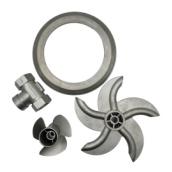
Die Casting: High Efficiency for Mass Production
How die casting works
Die casting is a high-speed manufacturing process in which molten metal is injected into a steel mold under high pressure. The mold, also known as a die, is reusable and designed for repeated use over thousands of production cycles.
The high-pressure injection ensures that the molten metal fills the mold completely, even in areas with complex geometry. Once the metal solidifies, the mold opens, and the finished part is ejected.
Advantages of die casting
Die casting offers excellent surface finish and high dimensional accuracy, making it ideal for producing parts that require minimal finishing. The process is also highly efficient, allowing for rapid production of large quantities of identical components.
Consistency is another major advantage. Because the molds are reusable and precisely engineered, each part produced is nearly identical, which is critical for mass production.
Limitations to consider
One limitation of die casting is that it is typically restricted to non-ferrous metals such as aluminum, zinc, and magnesium. Additionally, the initial cost of tooling is relatively high, which may not be suitable for small production runs.
Typical applications
Die casting is commonly used for automotive parts, electronic enclosures, appliance components, and consumer products. These applications benefit from the combination of precision, speed, and consistency.
Lost Foam Casting: Simplifying Complex Designs
How lost foam casting works
Lost foam casting is a modern variation of traditional casting techniques. It uses a foam pattern that is coated with a refractory material and placed inside a sand mold. When molten metal is poured into the mold, the foam evaporates instantly, leaving behind a cavity that takes the shape of the final part.
This process eliminates the need for removing the pattern, simplifying the casting process.
Advantages of lost foam casting
One of the main advantages of lost foam casting is its ability to produce highly complex shapes without the need for cores or parting lines. This reduces the number of components and simplifies assembly.
The process also improves dimensional consistency compared to traditional sand casting and allows for more integrated designs.
Limitations to consider
Lost foam casting requires careful control of process parameters. Improper handling can lead to defects caused by gas generation during foam evaporation. It may also be less suitable for certain materials or extremely high-precision applications.
Typical applications
Lost foam casting is widely used in automotive and industrial sectors, particularly for engine components and complex structural parts where design integration and efficiency are important.
Comparison of Common Metal Casting Processes
Casting Process | Surface Finish | Accuracy | Production Volume | Cost Level | Typical Use Case |
Sand Casting | Medium to Rough | Moderate | Low to Medium | Low | Large parts, heavy machinery |
Investment Casting | Smooth | High | Medium | Medium to High | Precision components |
Die Casting | Very Smooth | High | High | High (tooling) | Mass production parts |
Lost Foam Casting | Moderate | Moderate | Medium | Medium | Complex shapes |
Conclusion
Understanding the differences between casting methods helps you make better decisions when developing or sourcing casting parts. Each process has its strengths and limitations, and the right choice depends on your specific requirements, including part complexity, production volume, and performance expectations.
At Foshan Zeren Precision Casting Co., Ltd., we specialize in delivering reliable casting solutions tailored to different industries and applications. With advanced production capabilities and a strong focus on quality, we support our customers in selecting the most suitable process for their needs. If you are evaluating your next project or looking to improve product performance, we welcome you to contact us for more information and technical support.
FAQ
1. What are the most common types of casting processes for casting parts?
The most common types include sand casting, investment casting, die casting, and lost foam casting, each suited for different applications.
2. Which casting process provides the best surface finish?
Investment casting and die casting typically offer the best surface finish and require minimal post-processing.
3. How do I choose the right casting process for my project?
You should consider part complexity, production volume, material, cost, and performance requirements.
4. Are casting parts suitable for high-strength applications?
Yes, when the correct casting process and material are selected, casting parts can achieve excellent strength and durability.


