| Availability: | |
|---|---|
Product Overview
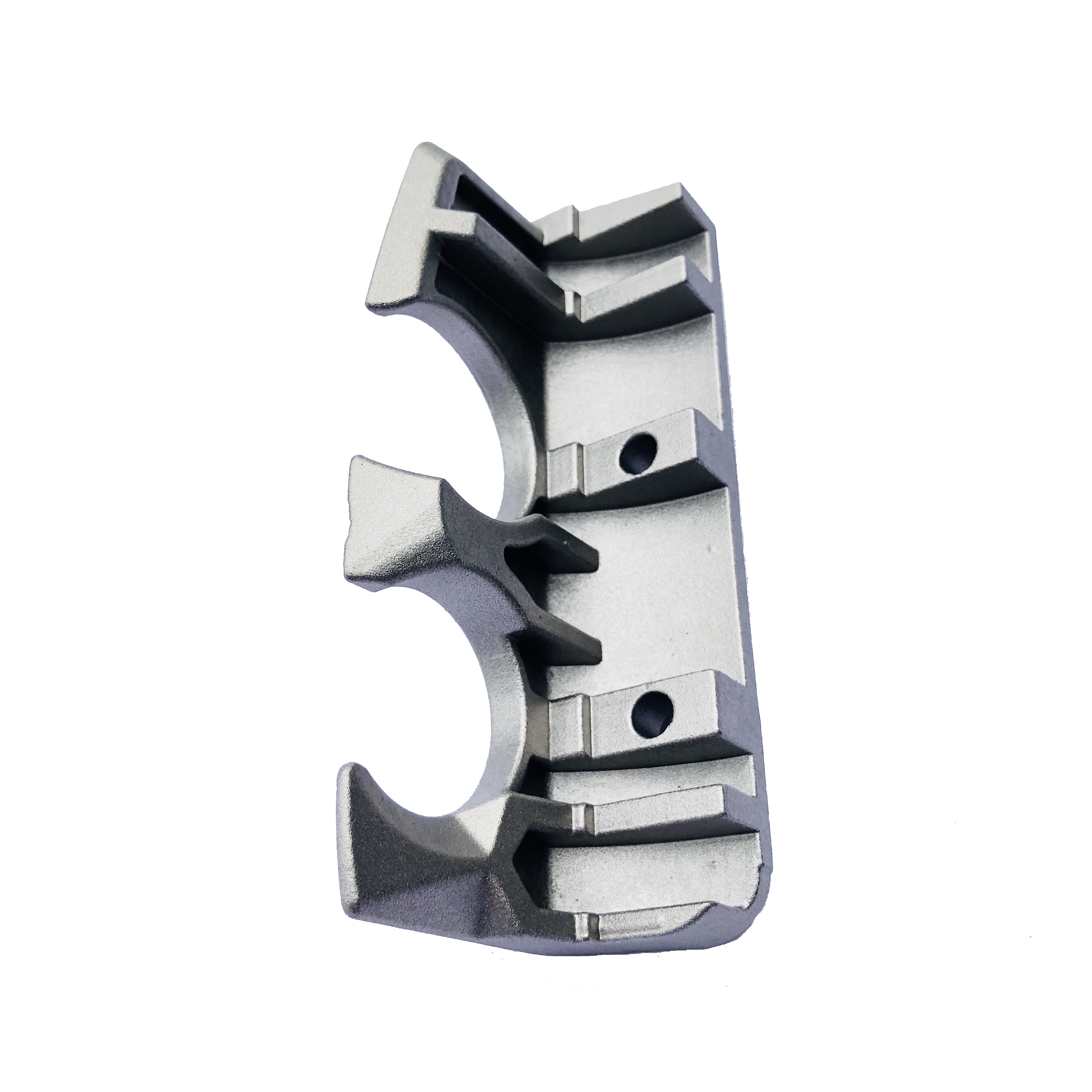
The bracket incorporates two large curved support profiles, multiple reinforcing ribs and mounting features into a single cast structure. These features would require significantly more material removal if the component were manufactured entirely from solid stock.
Investment casting allows the main geometry to be formed close to its final shape, while CNC machining can be concentrated on holes, mounting locations and other functional areas requiring tighter dimensional control.
Item | Details |
|---|---|
Product Type | Support Bracket |
Material | Alloy Steel |
Process | Silica Sol Investment Casting |
Secondary Process | CNC Machining as Required |
Heat Treatment | Available According to Material Grade |
Surface Treatment | According to Drawing Requirements |
Inspection | Dimensional & Material Inspection |
Production Type | Custom OEM Components |
Drawing Formats | STEP, STP, IGS, X_T, PDF, DWG |
Features
Curved support sections, mounting features and reinforcing ribs are formed within one casting, helping reduce separate fabrication and assembly.
Multiple ribs strengthen key areas of the bracket while maintaining an efficient overall component geometry.
Alloy steel can provide the strength and toughness required for mechanically loaded industrial components, depending on the selected grade and heat treatment.
Mounting holes, locating areas and other critical interfaces can be CNC machined after casting to meet drawing requirements.
Manufacturing
Silica sol lost wax investment casting is used to form the curved profiles, reinforcing ribs, mounting bosses and other complex external features of the bracket.
After casting, parts undergo gate removal, surface cleaning and preliminary inspection before secondary operations are performed according to the drawing.
Typical secondary operations may include:
Drilling mounting holes
Machining locating features
Finishing critical interfaces
Milling local surfaces
Heat treatment
Surface treatment
Final dimensional inspection
By combining investment casting with CNC machining, complex structural features can remain as-cast while tighter tolerances are applied only where they are functionally required.
The bracket contains curved internal profiles, reinforcing ribs, mounting bosses and varying wall geometry that would be inefficient to produce entirely by conventional machining.
Investment casting enables these features to be integrated into one near-net-shape component, helping reduce machining time, material waste and the number of separately assembled parts.
Different alloy steel grades can be selected according to required strength, toughness, hardness, wear resistance and service conditions.
Where required, heat treatment can be applied after casting to achieve specified mechanical properties.
Typical requirements may include:
Strength and toughness
Hardness control
Wear resistance
Impact resistance
Mechanical property consistency
Material grade and heat treatment condition are manufactured according to customer drawings and specifications.
Quality Control
For structural support components, dimensional consistency and material properties are important for reliable assembly and mechanical performance.
Inspection can be carried out throughout casting, machining and final production.
Chemical composition can be checked to confirm compliance with the specified alloy steel grade.
Curved profiles, mounting positions, hole locations and overall dimensions can be inspected against approved drawings.
Machined holes, locating surfaces and functional interfaces are inspected after CNC machining.
Where specified, hardness or related mechanical property testing can be performed according to customer requirements.
Applications
This type of alloy steel bracket can be customized for industrial machinery and mechanical assemblies requiring structural support, positioning or retention of cylindrical and related components.
Typical applications may include:
Industrial machinery assemblies
Mechanical support structures
Equipment mounting systems
Shaft or tube support assemblies
Positioning and retaining components
Heavy-duty mechanical hardware
All components are custom manufactured according to customer drawings rather than supplied as standard off-the-shelf brackets.
We manufacture different alloy steel grades according to customer drawings, required mechanical properties and application conditions.
Yes. Heat treatment can be arranged according to the selected alloy steel grade and specified mechanical property requirements.
Mounting holes, locating features, mating surfaces and other critical dimensions can be CNC machined according to drawing tolerances.
Investment casting is suitable for integrating curved profiles, reinforcing ribs, mounting features and other complex geometries into a near-net-shape component, reducing unnecessary machining.
Yes. Zeren manufactures custom investment cast and CNC machined machinery components based on 2D drawings, 3D models or existing samples.
Send us your drawing or 3D model for a manufacturing review. Our team can evaluate alloy steel selection, investment casting feasibility, machining requirements, heat treatment and inspection needs for your component.